From Autoresponders to Auto-Fixers
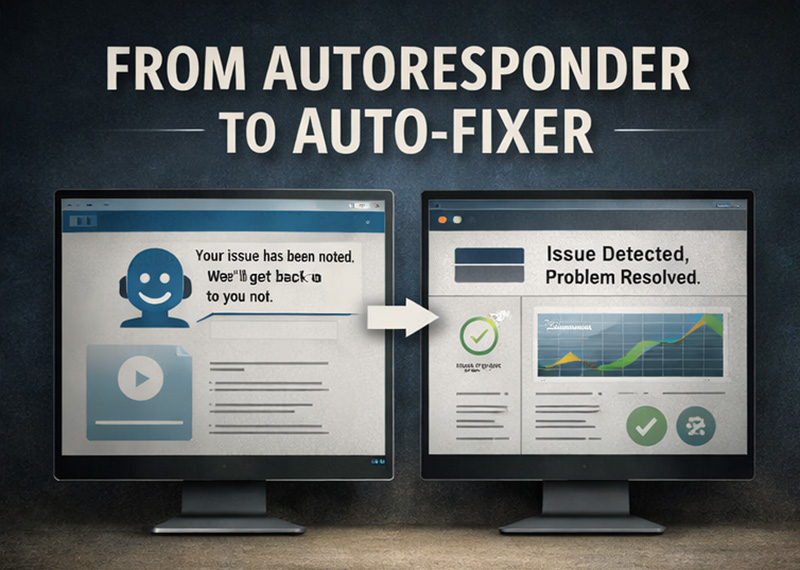 Autoresponders were supposed to liberate us. Instead, they gave us out-of-office loops, canned apologies, and the quiet erosion of trust.
AI risks repeating the same mistake.
Today, many organizations believe they’ve crossed some meaningful threshold because they’ve deployed chatbots, copilots, or “AI assistants.” The systems talk. They summarize. They politely acknowledge. They generate reassuring prose at scale. And yet—nothing actually happens.
This is the plateau of autoresponders. And it’s not the fulfillment of the AI future. The next phase of AI is not about systems that respond. It’s about systems that act.
The Autoresponder Mindset
Autoresponders are rooted in a conversational illusion: if the system can talk like a human, it must be intelligent. But conversation is the interface, not the work.
An autoresponder can tell you there’s a problem with your order, but you need an auto-fixer to automatically resolve it.
An autoresponder can apologize for a delayed shipment, only an auto-seller reroutes inventory, updates pricing, and preserves the relationship.
An autoresponder can summarize a performance issue, but you need an auto-improvement system to change the process that caused it.
Most enterprise AI today is still trapped in language models, and have not advanced to action models. It narrates reality instead of shaping it. It explains the dashboard instead of pulling the levers behind it to optimize things.
That’s not intelligence. That’s commentary.
From Words to Work
What changes when we move beyond autoresponders is subtle but profound: AI stops being a mirror and starts becoming a mechanism.
Auto-fixers don’t wait for tickets. They monitor systems, detect anomalies, propose interventions, simulate outcomes, and execute—with guardrails. Think less “How can I help you today?” and more “I’ve already handled it.” They are active, dynamic and outward bound.
Auto-sellers don’t spam leads. They sense intent across signals—behavioral, contextual, temporal—and adapt offers dynamically like a good sales executive. They know when not to sell. They optimize for lifetime value, not click-through rates. Most bots today act like a clumsy insurance salesman at a cocktail party, asking everyone up front if they need some insurance.
Auto-improvement systems don’t run quarterly retrospectives. They continuously adjust workflows, incentives, and learning pathways. They treat organizations as living systems, not static org charts.
And auto-innovation? That’s where things get interesting.
Auto-Innovation Is Not Idea Generation
We’ve already seen the shallow version: AI that brainstorms.
Auto-innovation is different. It’s not about ideas—it’s about selection, analysis, recombination, and execution under constraints.
Real innovation systems don’t just ask, “What could we do?”
They ask, “What should we do next, given our capabilities, risks, and strategic intent?”
An auto-innovation system understands tradeoffs. It models second-order effects. It tracks which ideas are being tested, which are compounding, and which are quietly dying. It doesn’t confuse novelty with progress.
In other words, it behaves less like a muse and more like a portfolio manager.
The Next Shift Is From Generative to Agentic
 This evolution—from autoresponders to auto-everything—requires a mental shift. Generative AI is about producing content. Agentic AI is about pursuing objectives.
Agents don’t just answer questions. They have goals, memory, tools, and the ability to coordinate with other agents. They operate over time. They close loops.
This is why the most important question for leaders is no longer,
“Where can we add a chatbot?”
but rather,
“Where do we want the system to take some responsibility?”
Responsibility is the dividing line.
Once AI systems are trusted to do, not just say, organizations begin to reorganize around them. Roles change. Metrics change. Governance changes. And yes—culture changes.
That’s uncomfortable. Which is precisely why autoresponders are so popular.
The Tao of Letting Go
There’s a Taoist irony here. The more tightly organizations cling to control—approvals, scripts, prompts, permissions—the more brittle they become. Autoresponders feel safe because they never surprise you. They also never transform anything.
Auto-fixers, auto-sellers, and auto-innovators require a different posture: set clear intent, define boundaries, and then get out of the way.
Not abdication, but alignment.
The future of AI is not a better conversation. It’s better outcomes with fewer conversations required.
And the quiet truth is this: when AI stops talking so much, you’ll finally know it’s working.